Boiler installation and repair
The heat source behind most hydronic radiant systems.
Learn moreRadiant floors heat the room from the surface up rather than blowing hot air around it. No draughts, no noise, no dust circulation, and warm floors on a January morning.

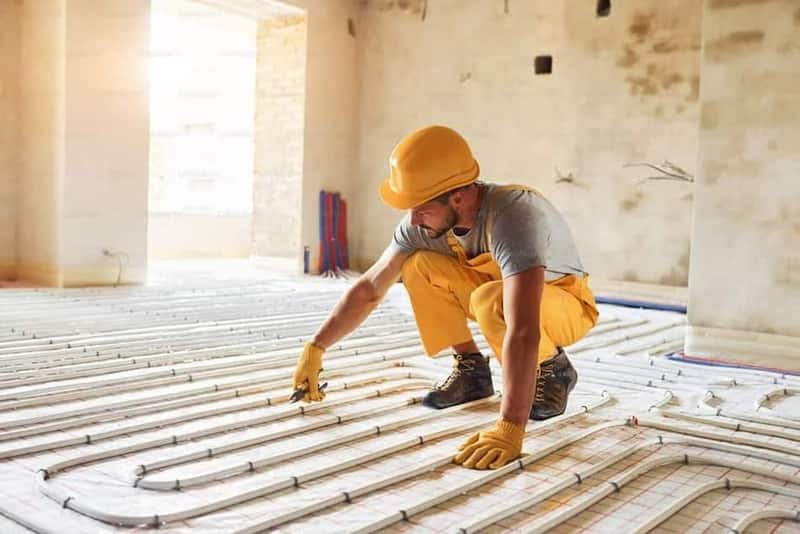
Warm water circulates through tubing embedded in or beneath the floor, and the whole floor becomes a low temperature radiator. Heat rises evenly across the entire surface rather than being blown from a few vents.
The result is a temperature profile close to what people find ideal: warm at floor level, comfortable at head height. Forced air does the opposite, delivering hot air at ceiling level that then has to mix downward.
Radiant runs at much lower water temperatures than radiators, typically in the 90 to 120 degree range rather than 160 to 180. That is why it pairs so well with condensing boilers and heat pumps, both of which are at their most efficient producing lower temperature water.
Radiant is not the right answer everywhere, and it is worth being honest about where it genuinely shines.
Concrete slabs are the ideal application. Tubing is laid before the pour and the slab becomes a large thermal mass that releases heat slowly and evenly. This is why radiant is so common in basements, shops, garages and outbuildings, and it is the single best heating solution for a workshop floor.
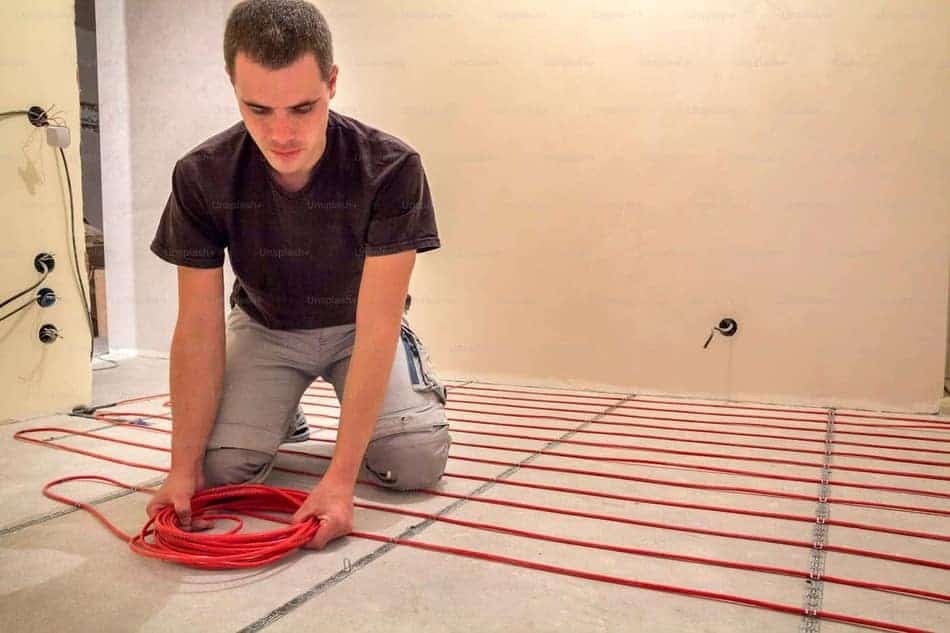
Bathrooms are the most popular retrofit. A warm tile floor is a genuine daily comfort improvement, and electric mat systems make it practical during a bathroom remodel without involving the whole house.
Whole-home hydronic radiant works best when designed in from the start, in new construction. Retrofitting into an existing home is possible via joist-mounted systems under the subfloor, but it is more involved and the performance depends heavily on the floor covering above.
That last point matters. Floor covering is part of the system. Tile and stone conduct heat excellently. Engineered wood is generally fine with the right specification. Thick carpet with heavy underlay insulates the floor from the room, which is precisely the opposite of what radiant needs. Choosing radiant means choosing floor coverings that work with it.
Response time is the other honest caveat. A slab system has a lot of thermal mass, so it takes hours to change temperature. Radiant wants to run steadily rather than being turned up and down.
Ask for an upfront price before any work starts.
Call (614) 756-0643Radiant systems are reliable, and the tubing itself rarely fails. Faults are usually in the mechanical room.
Same day and next day appointments are available across the valley.
Call (614) 756-0643The tubing is the durable part. Almost everything that needs attention is in the mechanical room.
On new installations, design comes first: loop layout and spacing, manifold locations, zoning, insulation beneath the tubing, and water temperature. Insulation under a slab is not optional, because without it a meaningful share of the heat goes into the ground rather than the room.
Timing matters on slab work. Tubing has to be laid, pressure tested and left under pressure through the pour, so the schedule has to coordinate with the concrete contractor. Leaving it pressurised during the pour is what proves nothing was damaged.
On repairs, we work the mechanical room first. Manifolds, circulators, zone valves, actuators, mixing valves and controls account for the overwhelming majority of radiant faults. A cold zone is far more often an actuator than a problem in the floor.
On controls, radiant needs setup that respects its thermal mass. Standard thermostat logic designed for forced air will overshoot and undershoot a slab continuously. Outdoor reset control, which adjusts water temperature based on outside conditions, is what makes a radiant system feel genuinely steady.
Snow melt systems use the same technology in driveways and walkways. They are worth mentioning here because they are a genuine Idaho application, and because they need their own controls and a glycol mix rather than plain water.
Book a licensed Meridian technician for this job.
Call (614) 756-0643Two quite different technologies that both end up as a warm floor.
| Hydronic radiant | Electric radiant | |
|---|---|---|
| How it works | Warm water circulated through tubing in or under the floor | Electric heating cable or mat beneath the floor covering |
| Best scale | Whole rooms, whole houses, slabs, shops and outbuildings | Single rooms, especially bathrooms and kitchens |
| Installation | Needs a heat source, manifolds, circulators and controls | Much simpler. Mat, thermostat and a dedicated circuit |
| Running cost | Lower for large areas, especially with a condensing boiler or heat pump | Higher per unit of heat, which is why it suits small areas |
| Retrofit friendliness | Harder. Joist systems are possible but involved | Very good during a floor replacement or remodel |
| Typical use here | New builds, basements, shops, whole-home systems | Bathroom and kitchen floors added during a remodel |
For a single bathroom during a remodel, electric mat is almost always the sensible choice. For a shop slab, a basement or a whole house, hydronic is the right technology.
Get this looked at before it turns into a bigger repair.
Call (614) 756-0643New installations are planned projects. Repairs are usually a single visit.
New construction, a remodel, a shop slab, or a fault on an existing system. These are very different conversations.
For new work, loop layout, zoning and heat source. For faults, the manifold and mechanical room first.
Including how the work coordinates with other trades on new construction, which matters for slab timing.
Tubing pressure tested and held under pressure through any concrete pour, or the faulty component replaced.
Water temperature, zoning and outdoor reset configured so the system runs steadily rather than chasing itself.
Request a visit and we will confirm your appointment window.
Call (614) 756-0643Radiant shows up in three fairly distinct situations across this valley.
Custom and higher end homes in Eagle, north Meridian, Star and the foothills frequently specify hydronic radiant, often for basements and main floors, sometimes whole-house. These are almost always designed in from the start with a boiler serving the loops.
Shops, garages and outbuildings are where radiant is most obviously the right answer, and this is genuinely common across the valley’s rural fringe and in Kuna, Middleton and Star. A slab with radiant tubing is far and away the best way to heat a workshop: it warms the floor you stand on and the objects in the space rather than trying to heat a large volume of air in a building with a big door that keeps opening. Anyone who has worked in a shop heated by a forced air unit heater in January understands the difference immediately.
Bathroom retrofits during remodels are the most common residential radiant work by volume, using electric mat systems under tile.
Treasure Valley winters routinely drop into the low twenties overnight in January, while July afternoons average near 92 degrees, so the same house has to survive hard freezes and high desert heat in the same year. It is worth noting that radiant’s steady low temperature output suits a climate with a long moderate heating season better than one with short extreme demands, and it pairs naturally with the condensing boilers and heat pumps that also suit this climate.
Source: Boise climate averages

Talk to a technician who works on Treasure Valley homes every day.
Call (614) 756-0643Radiant spans an enormous range, from an electric mat in one bathroom to a whole-home hydronic system. Quoted after scoping the project.
Have a licensed tech diagnose it and quote the repair up front.
Call (614) 756-0643The tubing is only half the system. Something has to heat the water flowing through it, and that choice affects both running cost and how the system feels.
| Heat source | Notes |
|---|---|
| Condensing boiler | The most common dedicated choice. Efficient at the low water temperatures radiant uses |
| Conventional boiler | Works, but is less efficient at radiant’s low operating temperatures than a condensing unit |
| Air-to-water heat pump | A heat pump that produces hot water instead of hot air, pairing naturally with radiant’s low temperature demand |
| Dedicated tankless or storage water heater | Sometimes used for small radiant zones, such as a single bathroom, rather than whole-home systems |
Whichever source is chosen, radiant works best when the water temperature is matched to the load rather than fixed at one setting year-round. That is what outdoor reset control does: it lowers the water temperature automatically in milder weather so the system does not overshoot, and raises it in genuine cold. It is worth specifying on any new hydronic radiant system rather than treating it as an optional extra.
Schedule service anywhere from Star to Mountain Home.
Call (614) 756-0643Because the tubing itself is largely inaccessible once installed, radiant troubleshooting focuses almost entirely on the mechanical room, which is good news for repair cost.
Ask for an upfront price before any work starts.
Call (614) 756-0643Radiant tubing itself is fairly straightforward to install. Getting the loop lengths, spacing and zoning right for the specific building is where projects succeed or disappoint.
Insulation beneath the slab is a detail worth confirming specifically, because a radiant system without proper sub-slab insulation loses a meaningful share of its output into the ground rather than the room, and that loss is essentially permanent once the concrete is poured. It is one of the few decisions in a home that genuinely cannot be corrected later without major work.
Same day and next day appointments are available across the valley.
Call (614) 756-0643Homeowners who have only ever lived with forced air heating are sometimes surprised by how different a radiant-heated room feels, and understanding why helps set expectations.
A forced air register delivers a burst of hot air at a single point, and that heat then has to mix through the room, which is why you can feel a distinct blast of warm air, followed by drafts as the system cycles off. A radiant floor delivers heat continuously and evenly across the entire surface you are standing or sitting near, so there is no single hot spot and no draft when the system cycles.
The other difference is what forced air moves besides heat. Every time a blower runs, it also circulates whatever dust, allergens and noise are already in the ductwork. Radiant systems move no air at all to deliver heat, which is part of why people with dust or allergy sensitivity often notice a difference, and why radiant rooms are generally quieter than forced air rooms.
The trade-off, covered above, is response time. A forced air system can raise a room’s temperature in minutes. A radiant slab takes hours to change, which rewards a steady setpoint rather than the kind of setback-and-recover schedule people commonly run on a forced air thermostat.
Book a licensed Meridian technician for this job.
Call (614) 756-0643For the right application, yes. Radiant delivers genuinely better comfort than forced air: no draughts, no noise, no dust being blown around, and an even temperature across the whole room with warm floors underfoot. It is most compelling in new construction where tubing goes into a slab before the pour, in basements and shops, and as a bathroom retrofit during a remodel. It is harder to justify as a whole-house retrofit into an existing home, where the installation is far more involved.
Yes, though it depends on the situation. Electric mat systems are straightforward when a floor is being replaced anyway, which is why bathroom remodels are the most common retrofit. Hydronic radiant can be retrofitted from below by mounting tubing between the floor joists, which works but is more involved and performs best with conductive floor coverings. Retrofitting into an existing concrete slab is generally not practical. The honest summary is that radiant is dramatically cheaper when it is planned in rather than added later.
Tile and stone are ideal, because they conduct heat well and store it. Engineered wood is generally fine, though solid hardwood needs care because of expansion and contraction, and manufacturers publish specific guidance. Vinyl and laminate usually have a maximum temperature limit that has to be respected. Thick carpet with heavy underlay is the problem case, because it insulates the floor from the room, which is the opposite of what radiant needs. Floor covering is genuinely part of the system rather than a decision you make afterwards.
A slab system takes several hours, because there is a lot of concrete to bring up to temperature. That is a feature rather than a fault: the same thermal mass releases heat slowly and evenly, which is what makes radiant comfortable. It does mean radiant is designed to run steadily rather than being turned up and down. A joist-mounted or electric mat system responds considerably faster because there is far less mass involved.
Nearly always something at the manifold rather than a problem in the floor. The usual suspects are a zone valve or its actuator failing to open, air trapped in that loop, or a balancing issue restricting flow. The tubing itself very rarely fails, which is good news because it is the one part that is difficult to reach. A cold zone is a mechanical room diagnosis, and it usually resolves quickly once the manifold is checked.
It is arguably the best possible application. A radiant slab warms the floor and the objects in the space directly, rather than trying to heat a large volume of air in a building with a large door that opens regularly. Anyone who has tried to heat a workshop with a forced air unit heater in January knows how quickly that heat leaves. Radiant slab heating in shops and outbuildings is common across the valley’s rural areas and around Kuna, Middleton and Star, and it is one of the jobs where the difference is most obvious.
Yes. Snow melt uses the same hydronic technology in driveways, walkways and steps, with tubing embedded in the concrete. It needs its own controls, which typically combine temperature and moisture sensing so the system runs when it is actually needed, and it uses a glycol mix rather than plain water because the loops are exposed to freezing conditions. Like slab radiant, it has to be installed before the concrete is poured.
Yes, and whole-home hydronic radiant is a legitimate primary heat source, particularly when it is designed in from the start of a new build. It does mean thinking through areas that do not lend themselves to floor tubing, such as small closets or rooms with extensive built-in cabinetry, where a supplemental source occasionally makes sense. For most homes, though, a well-designed whole-house loop layout adequately heats every room without needing a second system.
Running cost depends far more on the heat source than on radiant tubing itself. Because radiant operates at lower water temperatures than radiators, it pairs efficiently with a condensing boiler or an air-to-water heat pump, both of which perform best producing lower temperature water. Paired with an inefficient heat source, radiant will not automatically be cheap to run, so the heat source decision deserves as much attention as the floor system itself.
Outdoor reset control automatically adjusts the water temperature supplied to the radiant loops based on the outdoor temperature, running cooler water on milder days and warmer water in genuine cold. Without it, a system supplying a fixed water temperature year-round tends to overshoot room temperature in mild weather and can undershoot it in a cold snap, since radiant’s thermal mass responds slowly to a standard on/off thermostat. It is one of the details that determines whether a radiant system feels steady or feels like it is chasing itself.
Same day and next day appointments are available across the valley.
Call (614) 756-0643Design and installation for new builds, slabs and shops, and diagnosis on existing systems across Meridian, Eagle, Star and the wider valley.